More Buyers, Less FOMO: The Fall Market is Heating Up, But It’s Different This Time
Summer is officially coming to a close, and you know what that means: the fall real estate market is here.
Our market is incredibly seasonal. July is almost always one of our quietest months locally. School gets out, families travel, kids are at camp, and house hunting takes a back seat. Then September hits, everyone returns to real life, and the market wakes back up.
That gives us a relatively short fall window, roughly 60 days, before the holidays slow things down again. And I expect those 60 days to be active.
I’m not talking about national real estate here (Iowa is likely having a very different year). In Silicon Valley, the ingredients are lining up for a strong fall: extremely low inventory, plenty of buyers waiting for the right house, and an extraordinary amount of wealth being created locally.
But there is an important distinction. More demand does not necessarily mean a return to the frenzied markets we have experienced in the past.
Today’s buyer is different.
A Younger, More Deliberate Buyer
One of the more interesting shifts I’m seeing on the ground is the buyer demographic. The pool is getting younger, fueled in large part by tech compensation, equity and the tremendous amount of wealth being created across the Valley. But these buyers are approaching real estate differently.
A recent Redfin article said that nearly 14% of home purchases nationwide were canceled in July. That number alone doesn’t tell us much about Silicon Valley, but the psychology behind it does.
Buyers simply don’t have the same fear of missing out that we see during a truly hot market.
When people believe the house they don't buy today will cost more next week, they behave differently. They compromise. They stretch. They move quickly because they're afraid of being priced out.
That isn't what I'm seeing today.
Buyers are looking. Open houses are busy. They know the inventory and they're paying attention to sales. But they're also patient. They want the right neighborhood, the right house and the right price, and they're much more comfortable walking away when something doesn't make sense.
Interestingly, that same Redfin report showed cancellation rates approaching 20% in some Sun Belt markets, while San Francisco was just 4.1% and San Jose 6.5%. So our buyers may be deliberate, but when they find the right house and decide to move forward, they're much more likely to stay in the deal.
Where Are We in the Real Estate Cycle?
I get asked some version of this question all the time: Are we in a bubble? Are prices too high? Is there going to be a crash?
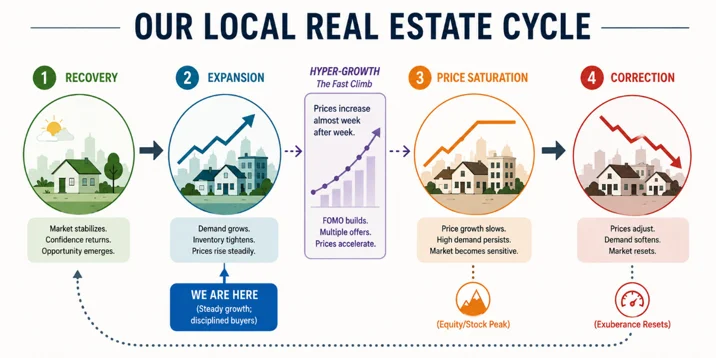
Real estate textbooks generally describe the cycle as Recovery, Expansion, Hypersupply and Recession. The problem is that Silicon Valley doesn't behave like a textbook real estate market.
In many parts of the country, developers respond to rising prices by building more homes. Eventually they build too many, inventory piles up and the market corrects.
We don't really have that problem here. Land is scarce, development is difficult and we chronically don't have enough housing.
Our version of "hypersupply" isn't too many houses. It's too much exuberance.
I've watched this happen cycle after cycle. Tech stocks take off, buyers watch their net worth climb, FOMO kicks in and suddenly people are stretching further and paying increasingly aggressive prices because they believe waiting will cost them even more.
Eventually buyers hit a wall.
Sometimes that coincides with a stock market correction. Sometimes it's broader economic uncertainty. Whatever triggers it, the psychology changes. The fear of missing out disappears, buyers become more discerning and prices recalibrate.
So Where Are We Today?
I believe we're in Expansion, but we're not in a hyper-growth market. And frankly, that's probably healthier.
Buyers aren't panicking and they're not blindly overpaying. They are willing to pay a premium for great homes, but they're much less forgiving of compromises.
I've said this before: a truly hot market is one where buyers make compromises because they're afraid not to buy.
That's not this market.
Today, a pristine home in a great location can still generate tremendous interest and a premium sale. Put a compromised property next to it, though, and you may see a completely different result.
That's why strategy matters so much right now.
Three Things Driving Our Market
Beyond buyer psychology, there are three fundamentals I continue to watch closely.
- Inventory remains incredibly low. A huge number of homeowners are sitting on mortgages below 4%. Unless life gives them a compelling reason to move, many aren't particularly interested in giving those loans up. That continues to restrict inventory and puts pressure on the limited supply of good homes.
- People want to be close to work again. Remember when everyone was moving to Tahoe, Austin, Montana or wherever they could get more space during the pandemic? Remote work fundamentally changed housing decisions for a period of time. That pendulum has swung back. Hybrid schedules and return-to-office mandates have made proximity to Silicon Valley employers, good schools and established communities important again.
- There is a tremendous amount of new wealth in the Valley. AI growth, stock appreciation, secondary sales and other liquidity events have put substantial capital into the hands of local buyers. That's important because our market is much more closely connected to equities and local wealth creation than it is to the national housing headlines.
What Does This Mean for Fall?
Barring a major economic or geopolitical surprise, I think we're set up for a strong fall and potentially a strong series of quarters ahead.
There will always be a wildcard. I've been doing this long enough to know you can't predict the headline that changes sentiment overnight. You simply adjust when it happens.
For buyers, I actually think this is an interesting market. The long-term fundamentals remain strong, but you don't have the completely irrational pressure that comes with a hyper-growth cycle. You can be thoughtful, but you also need to recognize when the right house comes along because inventory remains extremely limited.
For sellers, the lesson is equally straightforward: buyers will pay for great homes, but they're discerning. Preparation, presentation and pricing matter tremendously. And with the fall selling season compressed into such a short window, timing matters too.
The next 60 days should tell us quite a bit about where we're headed.
As always, if you're thinking about buying or selling, or just want to understand where your particular home fits into this market, give me a call. I'm always happy to talk real estate.
Let's connect to talk more about the specifics of your exact situation: