“I’m looking for the exact right house and I’m not in a hurry.”
If there is one phrase that defines buyer sentiment in 2026, this is it. If I put ten buyers in a room right now, I’ll get a nearly identical response from 90% or more of them. It is a fascinating paradox.
People are actively looking. Open houses are consistently busy, buyers are tracking local inventory and sales almost weekly, and dinner party conversations are mostly about real estate (and AI). So, why isn’t the market hotter? Why the lack of urgency?
Silicon Valley is home to some of the most intelligent and analytical people in the world. Because of that, the current hesitation is deeply calculated. Several distinct factors are shaping our local market right now, and they tell a compelling story about wealth, psychology, and the modern buyer.
The Liquid Wealth Dilemma: Real Estate vs. The Stock Market
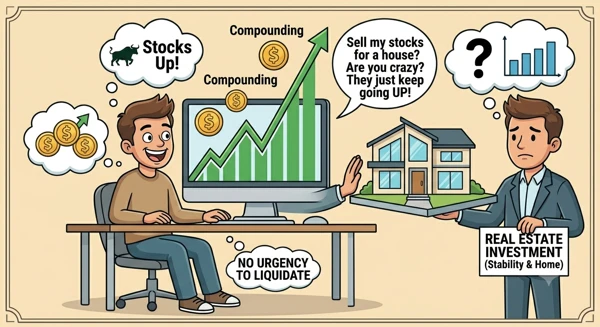
Many buyers believe their portfolios may provide stronger short-term growth than local real estate, making the decision to shift capital more complex. Let’s start with financing and how wealth is positioned today. For many local buyers, the funds intended for a home purchase aren’t sitting in a savings account – they’re invested in the equity markets. As a result, buying a home often requires a significant financial decision: whether and when to reallocate those assets.
When your stock portfolio is compounding at a healthy clip, or you are anticipating a strong company quarter that could significantly boost your net worth, your motivation to sell your stocks diminishes. Liquidating shares means triggering a tax event, pulling capital out of a high-performing vehicle, and stopping that money from working for you. If you believe the local real estate market is going to remain relatively flat or grow at a modest pace in the near term, the mathematical incentive to shift capital from equities to real property just isn’t there. Buyers still want to diversify, and they still want the stability and school districts that a home provides – but the urgent rush to pull the trigger is absent.
The Evolving Job Market
There is a tangible underlying anxiety regarding long-term employment stability – specifically at current income and compensation levels. Owning a home is a long-term commitment. With tech sector restructuring, ongoing corporate layoffs, and the looming question of how AI will structurally shift the workforce over the next decade, a lot of professionals are asking themselves if they can comfortably sustain the mortgage in ten years.
In a landscape where immigration and H1B visa status add another layer of vulnerability, it is entirely reasonable that buyers are moving with extreme caution. For some buyers, immigration status and long-term residency considerations add another layer of complexity to an already significant financial decision.
Analysis Paralysis: When Waiting for the Perfect Moment Comes at a Cost
While careful analysis is important, there is a point where too much deliberation can prevent meaningful action. I regularly meet buyers who have been searching for a home for five, seven, even ten years. These are often incredibly successful, intelligent individuals who are accustomed to optimizing every decision.
The challenge is that a home purchase is not a spreadsheet exercise with a single perfect answer. Markets change, life evolves, and waiting indefinitely for complete certainty can mean missing years of enjoying the very lifestyle you were hoping to create.
Breaking out of this cycle requires stepping back and assessing your personal situation with objective logic. If you find yourself stuck in the infinite search, ask yourself these foundational questions:
- Why do I want to buy a home now?
- How much can we comfortably afford based on our actual, current financial lifestyle?
- Do we realistically expect higher income or wealth accumulation in the coming years?
- What is our true time horizon for staying in the property we purchase?
- How does a home purchase fit into our broader wealth strategy and long-term diversification goals?
The Social Proof Factor: Why Buyer Interest Creates Momentum
What influences buyers more than almost anything else when searching for a home? The interest of other buyers. In any market, people look for signals that validate their decisions. Real estate is no exception. When buyers see a home generating strong interest, it reinforces the perception that the property is desirable and worth pursuing.
I often wonder what would happen if real estate transactions occurred entirely behind closed doors, without open houses, crowded entryways, or visible competition. Would buyers feel the same urgency? Would homes command the same prices?
This is why generating meaningful exposure and buyer engagement is such a critical part of my listing strategy. The goal isn't simply to put a home on the market. It's to create the right environment where buyers recognize its value, competition develops naturally, and my sellers achieve the strongest possible result.
Looking Ahead
Ultimately, we are navigating a market driven by calculation. Global macroeconomic uncertainty, regional employment shifts, and a booming stock market have given buyers the luxury of time – and they are taking full advantage of it.
If you are looking to buy right now, this lack of market frenzy is an incredible window of opportunity. It allows you to be highly deliberate, run your numbers calmly, and locate a property that aligns with your long-term financial strategy without much pressure. Just don't let the lack of external urgency turn into permanent hesitation.
The best time to buy has never been about timing the macroeconomic clock perfectly – it’s about finding the right asset, ensuring the math works for your lifestyle, and being ready to build for your future.
If you want to talk through how to position your own property or equity strategy in this environment, my door is always open.
Let's connect to talk more about the specifics of your exact situation: