What Silicon Valley stock growth could mean for local home prices
Buyers often tell me that Bay Area real estate has become too expensive. I understand why. A home in Los Altos, Los Altos Hills, Palo Alto, or Mountain View requires a level of capital that would be extraordinary almost anywhere else in the country.
But price alone does not tell the full story.
To understand whether something is truly expensive, you also have to consider the financial environment around it. In Silicon Valley, that means looking beyond home prices and examining the extraordinary amount of wealth created by the technology companies in our own backyard.
When I recently compared the performance of several leading local technology stocks with a Los Altos real estate example over approximately the same three-year period, the difference was striking. The home had appreciated by roughly 24%. The selected stocks had increased by approximately 94% to 667%.
In this short video, I explain why that disparity could matter for the next phase of the Bay Area housing market.
That does not mean home prices should rise at the same rate as technology stocks. It does suggest that the relationship between local wealth and local real estate may be more important than the headline price of a home.
The Scale of Silicon Valley Wealth Creation
The comparison included NVIDIA, AMD, Broadcom, Applied Materials, Intel, Alphabet, Meta, Cisco, Tesla, and Apple. Using split-adjusted share prices from May 2023 and a September 2026 market snapshot, every company in the group had appreciated substantially. Several had more than tripled, and NVIDIA had increased by more than sevenfold.
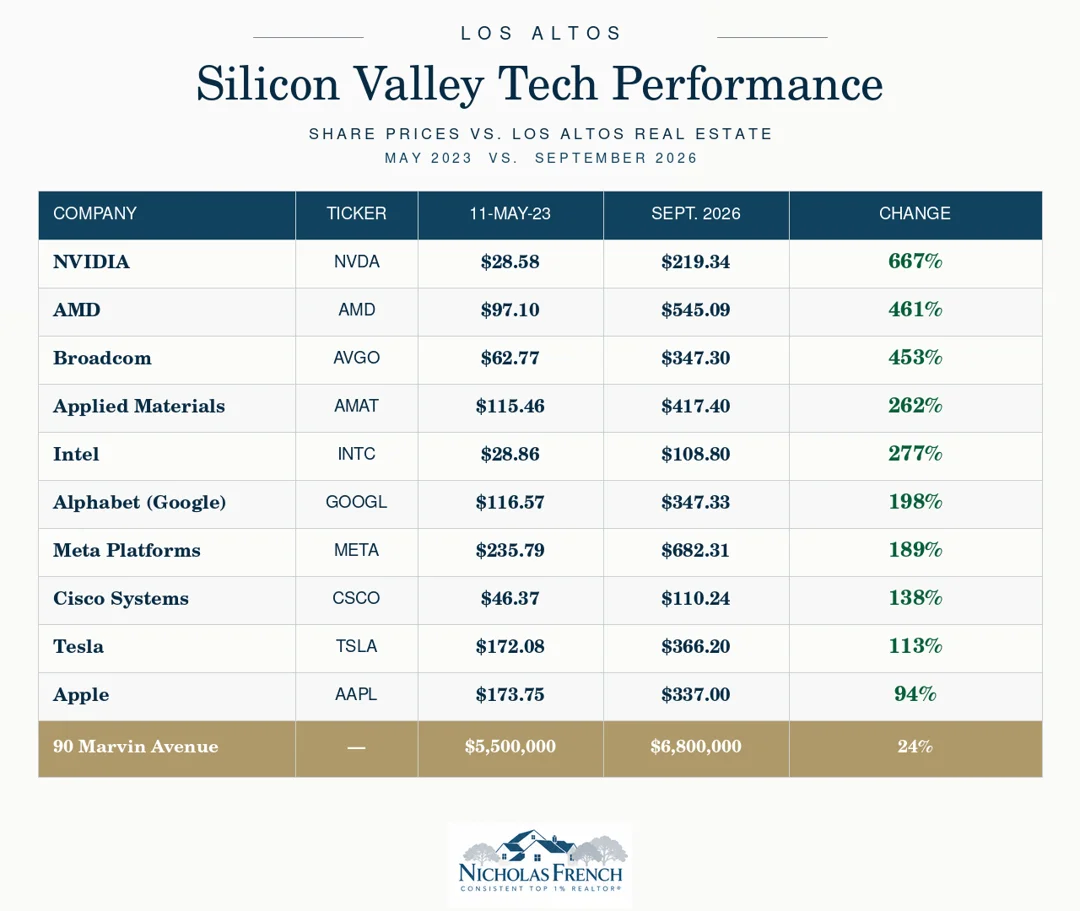
These were intentionally selected examples, not a diversified index of the entire stock market. Stock prices also fluctuate daily, and not every employee or investor participated equally in those gains. Even so, the comparison illustrates the scale of wealth that has been created locally in a relatively short period.
That distinction matters in the Bay Area because many prospective homebuyers receive a meaningful portion of their compensation through restricted stock units, options, or direct equity ownership. A rising stock price can materially change a household’s down-payment capacity, purchasing budget, and willingness to move.
Not all of that appreciation immediately becomes cash, and not all of it will move into housing. But it creates a deeper pool of potential purchasing power.
Real Estate Has Appreciated, but at a Different Pace
The real estate example in my client analysis was 90 Marvin Avenue in North Los Altos. Our comparison estimated a change from approximately $5.5 million in May 2023 to approximately $6.8 million in September 2026, or about 24%.
One property is not a housing index, and every home must be evaluated individually. Lot size, location, condition, floor plan, schools, walkability, and development potential all influence value. The Marvin Avenue comparison is simply a tangible local example viewed across the same general period as the selected technology stocks.
Still, the contrast is meaningful. A 20% to 30% increase in a home’s value feels dramatic when the starting price is several million dollars. But relative to the growth of many locally held technology assets, it can look considerably more moderate.
This is the part of the Bay Area real estate market that is easy to miss. Housing does not exist in isolation. It sits within one of the most concentrated wealth-creation ecosystems in the world.
Why That Purchasing Power Has Not Fully Reached Housing
Stock appreciation does not automatically produce an immediate wave of home purchases. Buyers may be waiting for lower interest rates, greater economic certainty, a vesting date, a liquidity event, or simply the right property. Some may be reluctant to sell appreciated shares and create a tax obligation. Others are already homeowners and have no reason to move until their needs change.
Bay Area buyers are also highly selective. Even households with significant resources will wait when available homes do not offer the right combination of location, lot, architecture, condition, and long-term potential.
That creates a form of latent demand: buyers may have the financial capacity to act without currently competing for a home. When the right properties appear, or when enough buyers decide that waiting is no longer serving them, that purchasing power can enter a market with chronically limited supply.
The larger question is what happens when more of that purchasing power enters the housing market. If even a portion of the buyers whose technology holdings have grown dramatically decide they are ready to purchase at the same time, they will be competing for a supply of exceptional homes that has not expanded at anything close to the same pace. That imbalance could create a period of hyper-growth in Bay Area real estate.
When buyers tell me today’s prices seem crazy, my response is simple: just wait until more of the wealth created here moves off the sidelines and into the housing market. If that happens, the prices we are seeing today may look surprisingly reasonable in hindsight.
This is not a prediction that every home will suddenly appreciate or that the market can only move upward. It is one reason I believe buyers should consider relative value, not just the absolute purchase price.
What This Means for Bay Area Buyers
I would never advise someone to buy a home simply because they are afraid prices might rise. A purchase should work for the buyer’s finances, lifestyle, time horizon, and tolerance for risk.
But waiting is not a neutral decision either. If a buyer is financially prepared, expects to remain in the area, and finds a property that genuinely fits, it is worth considering the amount of local purchasing power that could compete for similar homes in the future.
The better question may not be, “Is this home expensive?” Almost every desirable home in Silicon Valley is expensive by national standards.
The more useful questions are:
- How scarce is this particular property?
- What would it cost to reproduce its location, lot, and improvements?
- How does its appreciation compare with the growth of local incomes and assets?
- What are the risks and opportunity costs of waiting?
- Does the home remain a sound purchase under several possible market scenarios?
That is how sophisticated buyers should evaluate Los Altos real estate and the broader Silicon Valley housing market.
What This Means for Sellers
For sellers, substantial local wealth does not eliminate the need for strategy. Buyers may have the resources to pay a premium, but they still respond to quality, preparation, pricing, and presentation.
A home that is thoughtfully improved, properly positioned, and launched at the right moment can benefit from the depth of the local buyer pool. A property that is poorly prepared or inaccurately priced can still sit on the market, even when surrounding buyers have significant purchasing power.
The presence of wealth creates capacity. It does not guarantee urgency. The seller’s job, and the agent’s job, is to give buyers a compelling reason to act.
So, Is Bay Area Real Estate Actually on Sale?
“On sale” is intentionally provocative. I am not suggesting that Bay Area homes are inexpensive, nor that real estate should match the extraordinary gains of a small group of technology stocks.
I am suggesting that value is relative.
When home-price appreciation is viewed alongside the scale of wealth recently created by Silicon Valley companies, today’s prices can look less extreme than they do in isolation. If even a portion of that purchasing power moves into a housing market where exceptional properties remain scarce, current values may look very different in hindsight.
For buyers, that is a reason to remain prepared and evaluate opportunities carefully. For sellers, it is a reason to understand the financial capacity that exists beneath the surface of the market.
Bay Area real estate is expensive. But if the next wave of locally created wealth begins competing for a limited supply of homes, today’s market may be the opportunity buyers wish they had recognized sooner.
Considering a purchase or sale in Los Altos, Los Altos Hills, Palo Alto, Mountain View, or the surrounding Bay Area? Contact Nicholas French for a property-specific market analysis grounded in your goals, timeline, and financial position.
Let's connect to talk more about the specifics of your exact situation: